
- Start only if you have already run a half marathon. Run three or four days a week, with the long run growing to about 32 km and a lighter week every fourth week.
- Cut back in the last two to three weeks, practise your fuel and fluids on long runs, and start slowly on race day.
- In Indian heat, choose a cool-season race, run early, and take heat illness seriously. See a doctor first.
If you have run a half marathon, sixteen weeks of steady training can take you to your first marathon (42.2 km). Build the long run slowly, take a lighter week every fourth week, taper at the end, and practise your food and drink before race day.
Is this plan for you?
Nuffield Health's 16-week beginner marathon plan is written for people who have already completed 5K, 10K and half marathon distances, and says its aim is to get you to the finish in a pain and injury-free manner, with no target time. It asks you to get a GP check-up first and to think about any condition that could stop you running the distance. We agree. A marathon is a big load on the body; talk to a doctor if you have any health condition. If you have not yet run a half, start with the 12-week half marathon plan.
The table below is our own, in kilometres, built on the same pattern as published plans: a steady build, a half marathon as a milestone, cut-back weeks, a peak run in the low 30s of kilometres, and a taper.

The 16-week table
Run three or four times a week, with the long run on a weekend. Easy runs are at a talking pace. You can add a gentle cycle, swim or yoga on a rest day, as the Nuffield plan suggests, and a short strength session.
| Week | Easy run 1 | Easy run 2 | Long run | Note |
|---|---|---|---|---|
| 1 | 30 min | 30 min | 10 km | Build |
| 2 | 35 min | 30 min | 12 km | Build |
| 3 | 35 min | 35 min | 14 km | Build |
| 4 | 30 min | 30 min | 10 km | Cut-back |
| 5 | 40 min | 35 min | 16 km | Build |
| 6 | 40 min | 40 min | 18 km | Build |
| 7 | 45 min | 40 min | 21 km | Half marathon distance |
| 8 | 30 min | 30 min | 12 km | Cut-back |
| 9 | 50 min | 45 min | 24 km | Build |
| 10 | 50 min | 45 min | 26 km | Build |
| 11 | 55 min | 50 min | 29 km | Build |
| 12 | 40 min | 35 min | 20 km | Cut-back |
| 13 | 60 min | 50 min | 32 km | Peak |
| 14 | 45 min | 40 min | 22 km | Taper starts |
| 15 | 35 min | 30 min | 14 km | Taper |
| 16 | 25 min | 20 min | Race: 42.2 km | Race week |
Long runs and cut-back weeks
The long run drives the plan. Run it slowly: the Nuffield plan says to run slowly enough to hold the pace the whole way, which is the best way to avoid burnout. It also puts race pace at about 60 to 70 percent of maximum effort, a conversational pace. Every fourth week the distance drops (weeks 4, 8 and 12). These are not wasted weeks; they are when the body adapts to the earlier work. If you miss a run, the Nuffield plan treats it as an extra rest day and rejoins at the next scheduled run, without doubling up.
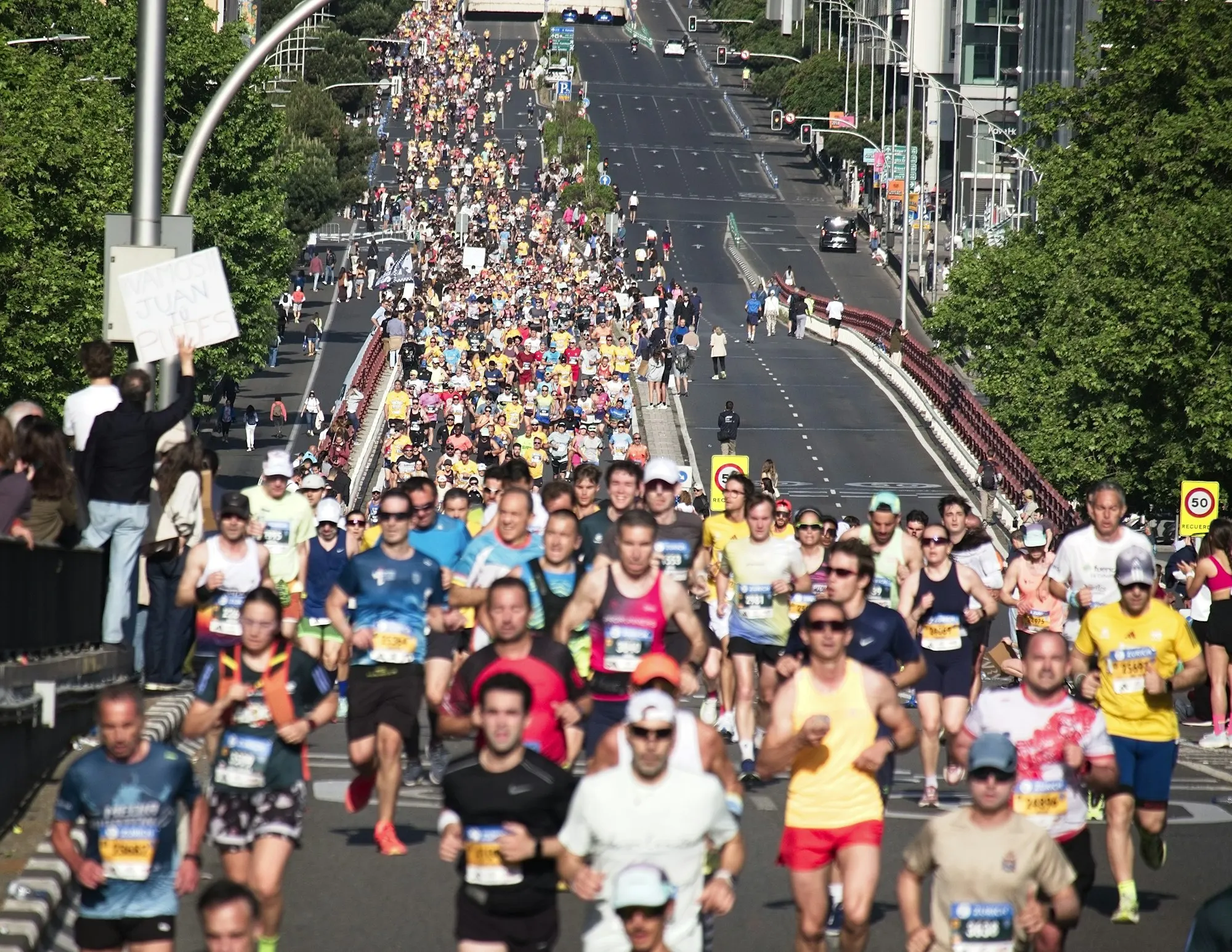
Taper and race week
From week 14 your distance falls, so your legs are fresh for race day. The Nuffield plan tapers a week before the race and notes that running the day before has no positive effect on performance, so rest, sleep and eat well instead. Lay out your kit the night before and nothing new on the day. Check the course, the cut-off time and where the water points are. For events, see marathons and half marathons in India.
Fuelling and hydration basics
A sports dietitian quoted by Runner's World suggests taking in 30 to 60 g of carbohydrate per hour for the first three hours of a marathon, rising to 60 to 90 g an hour after that, starting in the first 30 minutes and then every 30 to 40 minutes. The same article puts a general fluid guide at about 300 to 800 ml an hour, depending on temperature, sweat rate and thirst, and says sweat rates vary hugely between people. It also mentions sodium and electrolytes, and says to start drinking well before the race.
The key advice from that article and from Nuffield Health is to practise everything in your long runs, and to try nothing new on race day. On race morning, eat something light that your body is used to, and drink enough without overdoing it. Because needs differ, especially if you have diabetes, kidney problems or take medicines, ask a doctor or sports dietitian for a plan that fits you.
Indian heat
Heat is the biggest extra challenge for a marathon in India. Doctors quoted by Runner's World recommend running in the cooler hours, wearing light, breathable clothing, acclimatising gradually, running with a buddy, and not waiting for thirst. They list headache, dizziness, nausea, fatigue and lightheadedness as signs of heat exhaustion, and disorientation or blacking out as signs of heatstroke, which needs urgent medical care. The NHS says heatstroke signs include hot skin that is not sweating, fast breathing, confusion and loss of consciousness, and that heatstroke is an emergency.
- Choose a race in a cooler month and in a cooler place if you can.
- Do most training runs early in the morning, and some at race-time hour so you can see how it feels.
- On race day, slow down if it is hot. Finishing is the goal.
- Stop and get help if you feel unwell. No medal is worth it.
Read more in running in Indian heat and monsoon and running and air quality in India.
When to see a doctor
Before you start, and again if anything changes. Stop and get help for chest pain, severe breathlessness, fainting or dizziness. See a doctor or physiotherapist for pain that gets worse as you run or does not settle; see beginner running injuries. Check your shoes too: running shoes for Indian roads. Long runs are easier with company, so consider a club: how to join a run club, run clubs, and Treqz Crew (coming soon).
General information, not medical advice.
Sources
- Nuffield Health: 16-week marathon training plan
- Runner's World Australia: Fuelling for a marathon
- Runner's World South Africa: running in the heat
- NHS: Heat exhaustion and heatstroke
Quick questions
Can I run a marathon after one half marathon?
Many people do. Nuffield Health's 16-week plan is written for beginners who have already done 5K, 10K and a half marathon. Get a check-up first.
How long should my longest run be?
In our plan, 32 km. The Nuffield plan peaks at 20 to 22 miles (about 32 to 35 km). You do not run the full distance in training.
How much should I drink and eat during a marathon?
A sports dietitian quoted by Runner's World suggests 30 to 60 g of carbohydrate per hour for the first three hours, then more, with fluids of roughly 300 to 800 ml an hour depending on heat and sweat. Practise in training.
Is it safe to run a marathon in Indian heat?
It can be dangerous in hot weather. Choose a race in a cooler month, start early, slow down, and stop for signs of heat illness. Heatstroke is an emergency.